
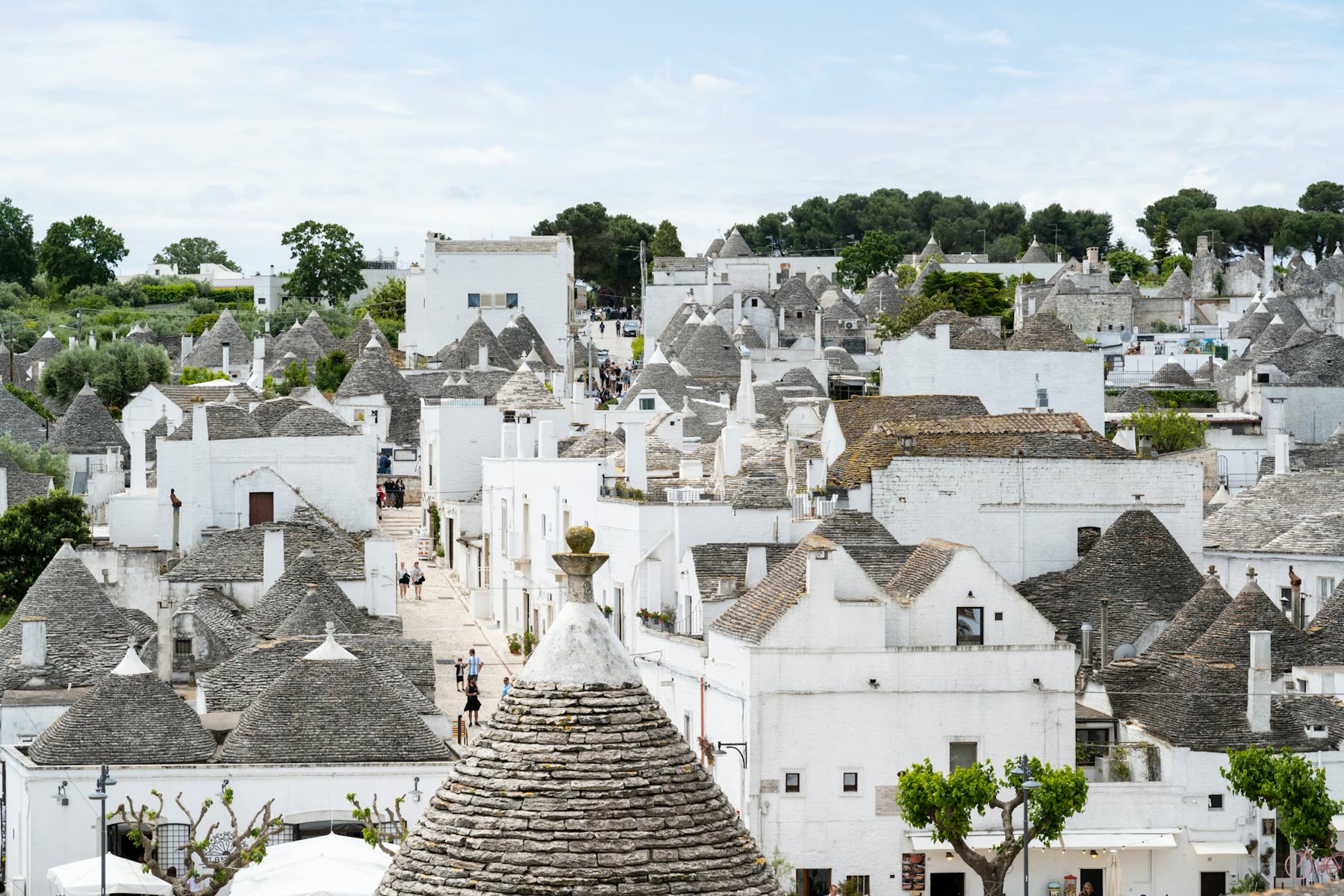
I am convinced that, when you close your eyes, they are precisely what appears in your imagination — the trulli.
Where did they come from? They are so different from the architecture we know elsewhere in Europe. Some people even say they resemble African huts.
No one knows for certain when they first appeared or why they look this way. According to the most likely theory, it was all about… taxes.
In the days of the Kingdom of Naples, taxes were imposed on completed buildings. A roof was apparently the sign that a house was finished. The resourceful people of this land therefore developed a way of building roofs that allowed them to be dismantled quickly and — at least according to legend — avoid the tax.
How much truth is there in it? That is hard to decide today. One thing is certain: Puglia is full of trulli, and Alberobello has become their symbol.
It is an essential stop for almost every visitor to the region. Interestingly, you can not only stay in a trullo, but also buy one. Contrary to appearances, they are not always as expensive as you might expect.
I will be honest: I have had my fill of the place. I think Puglia has dozens of places that are just as beautiful, and often more interesting. In high season it can be unbearably hot and crowded, and the number of visitors takes away some of its charm.
That is why I recommend Alberobello outside the season — ideally between late September and the end of March. It is quieter, cooler and, above all, finding somewhere to park is easier.
Would I advise you not to visit? Absolutely not.
It is simply an intriguing place and one you should see at least once. In fact, it is the first town to which I take friends visiting me in Puglia. We often drive there straight from Bari airport.
Incidentally, what intrigues me most is the town’s name itself. Alberobello means “beautiful tree”. I admit the place brings many things to mind, but trees are certainly not among them. Stone, perhaps.